

Facts Don't Lie, Or Do They?
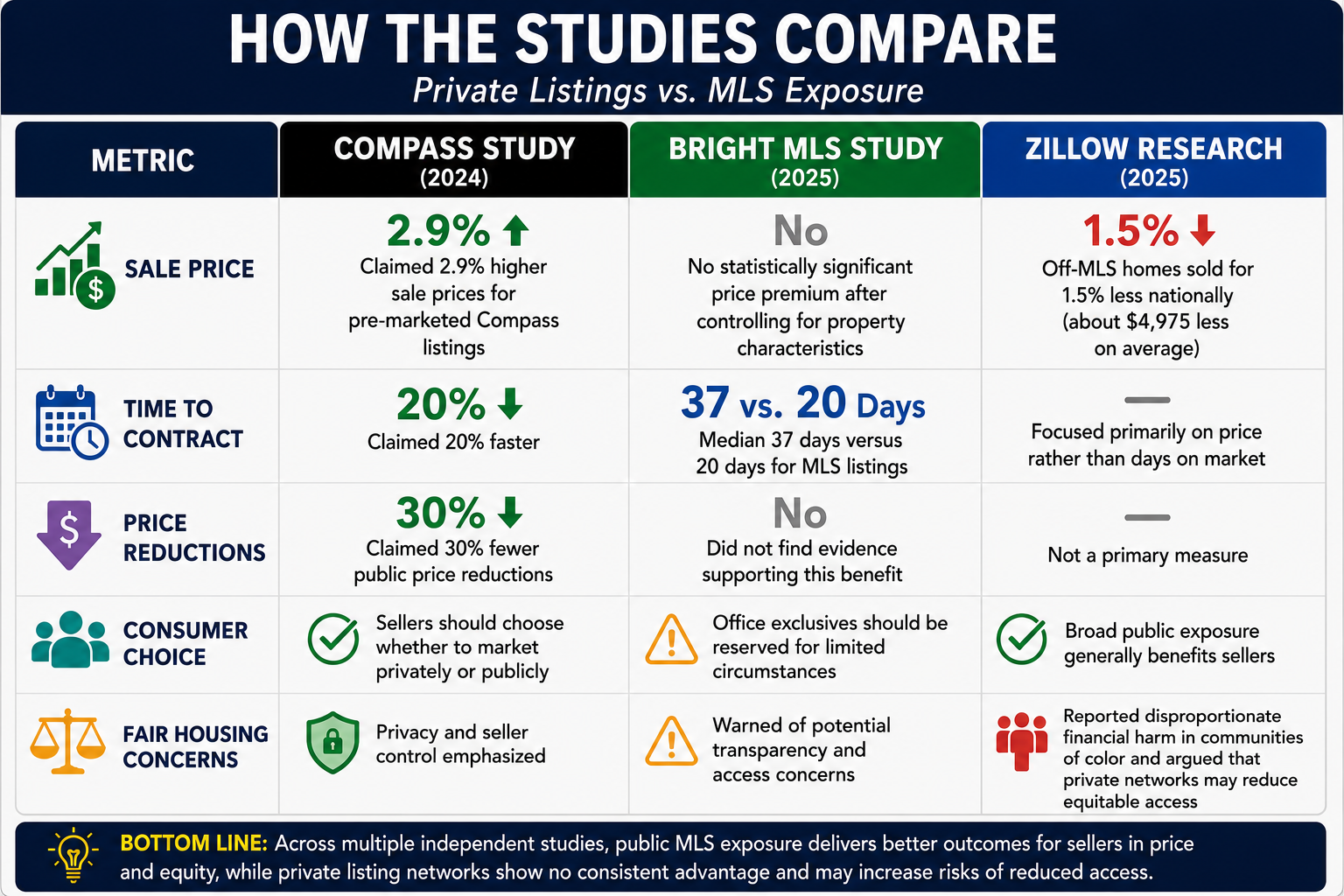
The key players in the private, exclusive listing debate are amping up their game by producing surveys/studies about the effectiveness or ineffectiveness of not marketing a home on the MLS. I have included a comparative analysis at the bottom here to help you see that data isn’t always what it seems. It compares data from Compass International Holdings (CIH), Bright MLS, and Zillow. If you are unfamiliar with Bright MLS, it includes all or significant portions of:
Delaware
Maryland
New Jersey (primarily South and parts of Central New Jersey)
Pennsylvania (including the Philadelphia, Harrisburg, Lancaster, York, Reading, and surrounding markets)
Virginia
West Virginia (primarily the Eastern Panhandle and nearby markets)
Washington, D.C.
The most recent Bright MLS study referenced here on 'office-exclusive listings' is frequently cited because it analyzed approximately 100,000 residential transactions across a large, diverse, multi-state MLS, rather than relying on data from a single brokerage or portal.
Here is what you need to know about these study results:
Compass's position
Pre-marketing creates seller leverage.
Testing pricing privately can improve negotiation. (Which is bad for buyers)
Avoiding public 'days on market' and visible price reductions protects perceived market value. (Also bad for buyers)
Their analysis suggests measurable increases in sales prices.
Bright MLS's position
After adjusting for home characteristics, there is no measurable price benefit.
Office-exclusive listings generally took longer to reach contract.
Most office exclusives eventually entered the MLS anyway, suggesting they function primarily as delayed public listings rather than an alternative sales channel.
Zillow's position
Maximum public exposure generally produces the strongest seller outcomes.
Sellers who remained off the MLS left an estimated more than $1 billion on the table collectively during 2023–2024. (Not sure how that was calculated)
The estimated loss averaged about $4,975 per sale nationally, with substantially larger losses in states such as California and in many communities of color.
You can go back in time to a study Bright MLS did with Drexel University for the period 2019-Q1 2023, covering 1 million residential transactions, when just about everything was in the MLS. Bright published data that ‘off-MLS’ listings sold for 17.5% less than properties in the MLS. Their newest study claims no significant increase or decrease in sales price based on MLS presence. The Bright MLS findings directly contrast with claims made by Compass, which has argued that its private exclusive strategy can:
Produce higher sale prices
Gives the illusion of a new listing without days on market or price reductions
Give sellers more control over timing and pricing
Bright MLS found no evidence of higher sale prices and found that homes marketed privately generally took longer to sell. The three analyses also differ in methodology:
Compass relies primarily on its own internal transaction data and compares outcomes within its brokerage. An unknown number of data sources.
Bright MLS analyzed a broad regional MLS dataset (100,000 homeowners) across many brokerages and controlled for home characteristics and location.
Zillow's study was conducted by their internal economics research team, which included 2000+ homeowners.
Each study has strengths and limitations:
Compass: Uses its own internal transaction data. Because it is not an independent study, critics argue the results may reflect Compass's client mix, agent practices, or market selection. What is left out of their study is how many in-house sales they made by not initially listing the property in the MLS for all agents to see and show to their clients. Seems like the fox guarding the hen house.
Bright MLS: Conducted by an MLS rather than a brokerage and controlled for several property variables, but its findings are based on one regional MLS footprint. Bright is one of the most well-respected MLSs in the country. I suspect that if this survey were replicated across the country, the results would be approximately the same.
Zillow: National in scope and compares MLS versus off-MLS sales, but Zillow is also a market participant with business interests tied to broad listing exposure. Zillow knows the key to its success is having access to and control over listing data, which it is currently being deprived of by CIH and its affiliates in the private listing camp.
It's getting the wrong kind of attention.
Several national consumer advocacy, civil rights, and fair housing organizations have publicly expressed concerns about the growth of private exclusive listings and private listing networks. CIH has partnered with Redfin and a few other MLSs to draw attention away from this practice and create the illusion of widespread exposure. The DOJ and FTC have taken notice. The organizations raising red flags are Fair Housing Alliance (NFHA), Consumer Federation of America. National Association of Real Estate Brokers, and the National Association of Hispanic Real Estate Professionals. While each of the above organizations has a slightly different opinion, they tend to share several concerns:
Listings marketed only within a brokerage or limited network reduce market transparency.
Sellers may receive fewer offers because fewer buyers know the home is available.
Buyers outside a brokerage's network may never learn about available properties.
Private marketing can create fair housing risks if access is uneven across communities.
Public MLS exposure generally promotes competition and equal opportunity.
Their concerns generally focus on consumer transparency, equal access to housing, and fair housing compliance, rather than opposing every private listing situation. Everyone agrees there are certain situations that merit it, but it is up to the brokerage and agent to clearly define the pros and cons for the seller. A seller always has a choice regarding public marketing. The brawl is primarily over MLS exposure. But it is just common sense that more eyeballs mean more potential buyers.
What's happening at the state level?
As of July 2026, only a handful of states have enacted legislation or are actively considering legislation specifically addressing private exclusive listings (office exclusive, pocket, or private networks). As more consumer groups become more vocal, the feds get involved, and lawsuits increase, states will have no choice but to take a hard look at whether they should act, since the ability of brokerages, MLSs, and portals to self-govern has apparently left the building.
It is just a matter of time before some savvy attorneys have enough transaction data to pull together a class action lawsuit. Ensure you are doing the right thing for your sellers, especially if they are transferees. And make sure the RMC and the corporation understand the pros and cons and what they may mean for a listing's sale price and market time.
Well, that pretty well sums it up. I have done my best to interpret this data, so you don't have to. For more specifics from these studies, you can hit up HousingWire, Inman News, Real Estate News, and RIS Media.