

Going for Gold: Lessons from the World’s Greatest Stage
Welcome to 2026! Here we are, almost two months in, and it's already proving to be an interesting year. You'll notice I didn't say 'great' or even 'good'. All I can say is thank goodness for the Winter Olympics to give us a much-needed respite from everything going on in the world. I am a big fan of the Olympics for many reasons, but the Winter Olympics put on an especially great show. Partly because of the danger involved in almost every category (except maybe curling, but I guess you could pull a hamstring), and the fact that the athletes compete and train in such crazy and dangerous conditions. There was also So. Much. Drama this year. Honestly, too much to even get into. I’ll just say there were cheating scandals (romantic and in events), wedding proposals, social media disses, and devastating injuries (bless Lindsey Vonn). Even if you don’t like sports, tune in for the tea. But there was also amazing camaraderie, teamwork, huge comebacks, overtime victories, American pride, and many records shattered. And you could get a daily Olympic village food review from Ben on the US Curling team if you were so inclined.
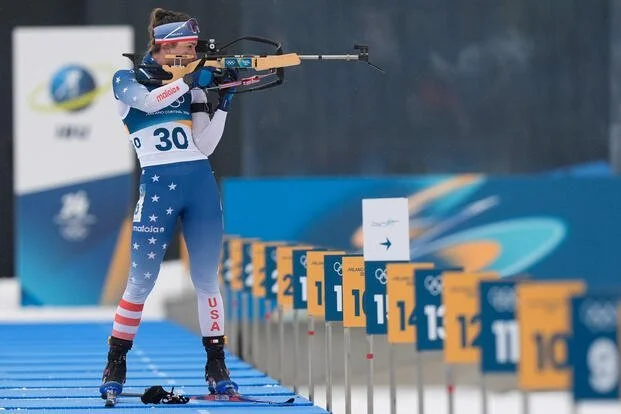
I think my favorite winter competition besides any skating event is the Biathlon (although the new event, Skimo (Ski Mountaineering), is pretty intriguing). If you don’t know what I am talking about, the Biathlon boils down to cross-country skiers carrying rifles on their backs and shooting at tiny targets while exhausted, and their chests are heaving from being out of breath. Here’s how it goes down.
Athletes ski a set distance (varies by event, some are team and some are individual)
They stop at a shooting range multiple times (standing and prone shooting).
At each stop, they fire 5 shots at targets.
Must hit the target three times, and missed shots result in a variety of penalties, such as adding a longer route to the finish line.
Why is the Biathlon not popular here like it is everywhere else in the world? I asked ChatGPT why, and here is what it said: "Biathlon isn’t popular in the U.S. because it lacks deep cultural roots. The Biathlon evolved from Scandinavian military ski patrol training. Our infrastructure is limited, expensive, and hard to access. Media exposure is minimal, and it competes with major American sports. And it doesn’t have consistent U.S. star power." Too bad, it's a kick to watch.
But I think the most joyful part of this year’s Olympics was watching Alysa Liu, with her striped hair and decorated teeth, win the free skate gold medal for the US. The first for the US Women since 2002. This is a kid who gave up on her grueling sport at 16 because it wasn’t fun anymore. Only to come back two years later with a new perspective. She said she wasn’t in it to win a medal or any competition, and by taking that pressure off, she was free to skate for herself and the fans, and it showed on her face and in her performance. To paraphrase a comment from her, "What matters is the input and the journey on my own terms."
So with all that being said, I think handling relocation is sort of like competing in the Biathlon. You know me, I always have to find an analogy. Sometimes it feels like we are fighting uphill in rough conditions, required to hit unrealistic targets while gasping for our next breath. But if we approach our roles the way Alysa Liu does by releasing some of the pressure and focusing on the pure fulfillment and joy that comes from helping others at such a stressful time, we can reconnect with the reason we chose this work in the first place. Here's to a gold medal 2026 on your own terms!